
The term “Mental Health” has always had a negative connotation associated with it, indicating that people with mental health issues are very different from other “healthy” people. In fact, every single person suffers from some type of “mental health” issue at some point in their lives. Even being angry and storming out on a given day is a type of mental breakdown. The difference between the so-called “mentally healthy” person and a “mentally ill” person is that the ill person finds it difficult to return to the normal state of mind quickly and without external help and guidance. However, every single human can use help and guidance to navigate the stress, anxiety, and depression caused by situations in life. It is about time that physical and mental health are treated equally so people can address their mental health conditions early without any social stigma. In fact, taking care of our mental health by learning to manage stress and anxiety is one of the key measures to manage and even cure chronic diseases such as high blood pressure and diabetes. Most problems in this world can actually be solved if people acknowledge and address their mental inabilities with the assistance of their loved ones or therapists. But how accessible and affordable are mental health services? And how discreet are these services to a common man that already feels stigmatized by these conditions? The answer could easily be the availability of telemental health services to augment existing traditional approaches.
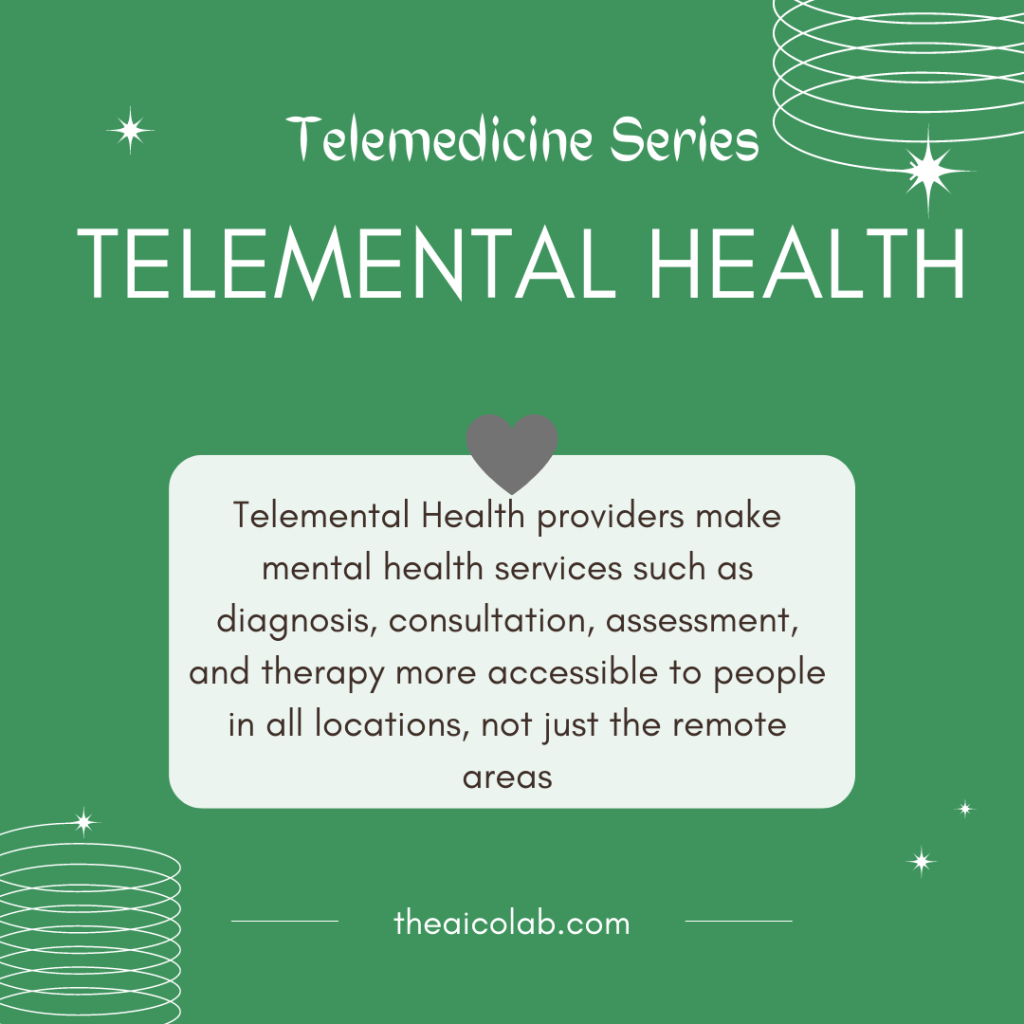
Mode of delivery
In traditional telemental health services, providers and patients use telephone calls, text messaging, emails, online chat forums, etc., for crisis management and consultation. Guided therapies facilitated by asynchronous telepsychiatry, text messaging, and smartphone apps are popular these days. They significantly reduce the need for human interaction, thus cutting costs, and geospatial and time barriers. Usually, patients with mental health problems are reluctant to have human interaction and are more comfortable interacting with machines. In such cases, Artificial Intelligence (AI) could also play a critical role in advancing mental health service delivery (Journal Article). Many apps use passive data to infer behavior from sensors and activities. For example parameters such as the total number of outgoing calls, location-based absolute distance traveled, voice modulations, speaking rate, and voice quality could all be valuable along with the clinical symptoms to train AI-based predictive models to predict symptoms of mental health issues such as depression and Post Traumatic Stress Disorder (PTSD).
Benefits
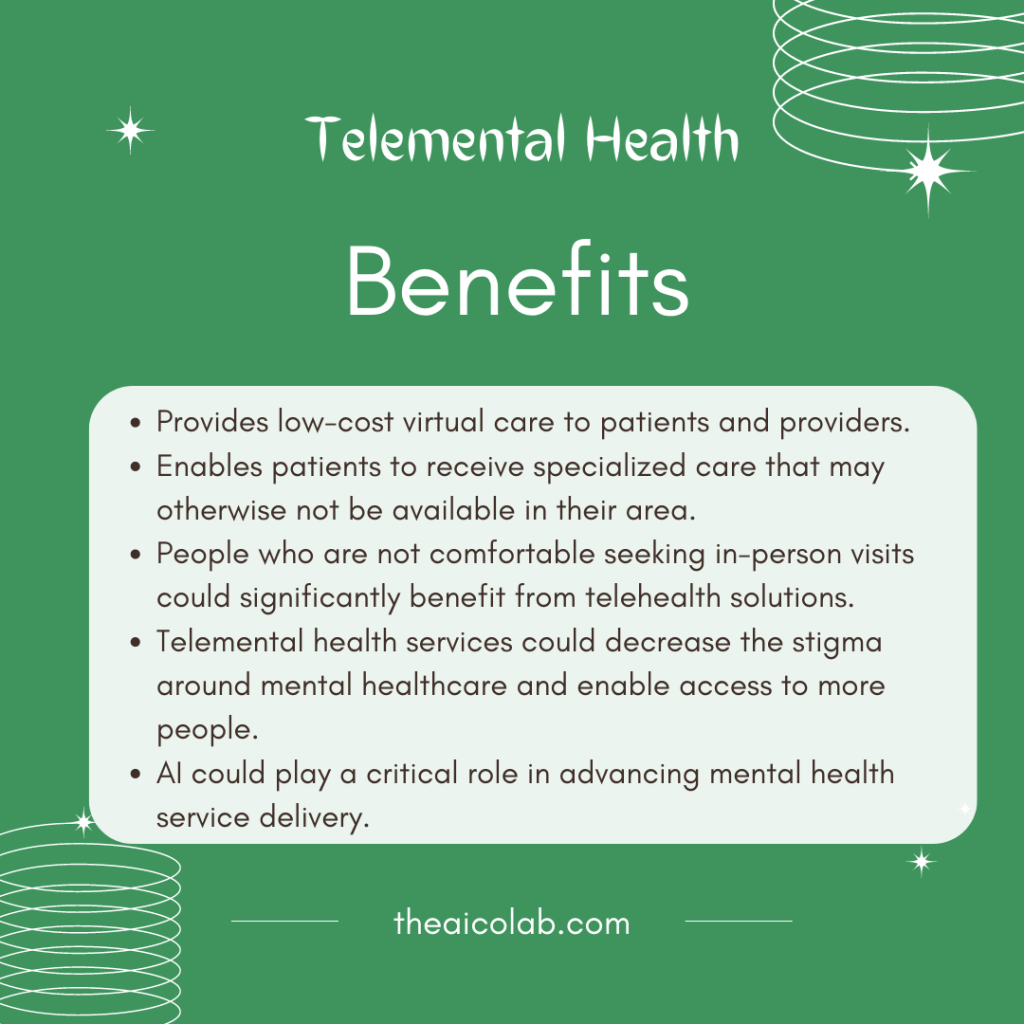
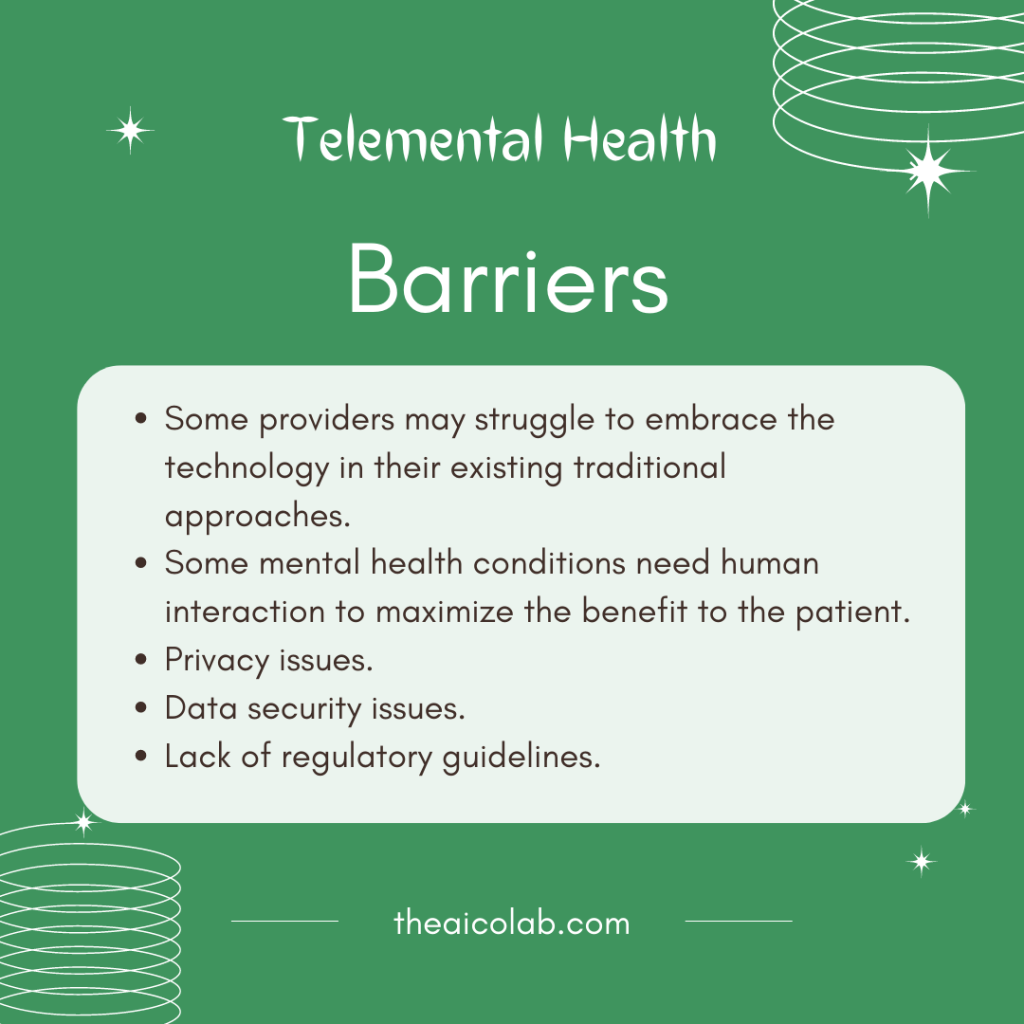
Barriers
Telemental Health Market
Data Bridge Market Research states that the telemental health market was valued at USD 109744.97 million in 2021. They estimate the market to reach USD 710577.49 million by 2029, growing at a CAGR of 26.3% during the forecast period.
Telemental Health providers
For Therapists:
- Secure Telehealth: Psychiatrists and mental health providers can use their computers and webcams to provide assessments and therapies through the Secure Telehealth app.
- SimplePractice: SimplePratice has a behavioral health EMR software that includes therapy billing, appointment scheduling, telehealth, online intake forms, etc. The telehealth platform is secure and HIPAA-compliant integrated with video calls that can help mental health providers to engage with patients in real-time to share exercises, goal-tracking worksheets, etc.
- TheraPlatform: TheraPlatform is a HIPAA-compliant video conferencing and practice management software supporting teletherapy. There are options for group teletherapy for family, marriage, etc. The platform also has an integrated whiteboard that the providers can use for explaining concepts and allowing the patients to do therapeutic exercises such as painting, drawing, etc.
For Patients:
- Array Behavioral Care: Array Behavioral Care is one of the largest telepsychiatry service providers in the US that provides behavioral healthcare to both patients at home and clinicians at hospitals. Their AtHome service connects patients to licensed therapists and psychiatrists through video calls for talk therapies, psychiatric assessments, medication management, etc.
- Talkspace: Talkspace is a 24/7 text-based therapy service that provides therapies for individuals, couples, and teens. Once the user takes a brief assessment, the app connects them to an appropriate therapist, who then takes the time to text message and provide therapy.
- Betterhelp: Betterhelp is also a 24/7 text-based therapy service that allows the user to message their therapist anytime, anywhere without the need for scheduling.
- My Online-Therapy: My Online-Therapy provides access to first class psychologists in multiple different ways, and also include digital psychological and educational tools. Their goal is to make therapy as accessible as possible.
- Manastha: Manastha provides online therapy and counseling in India and around the globe. The users can consult online psychologists, therapists, counsellors, mental health experts via chat, phone or video call without the fear of social stigma.
- Mental Health Apps: Several smartphone-based apps have been developed to support users in handling mental health issues. These apps are reasonably priced, sometimes free, and offer a wealth of resources that are available 24/7. Many of these apps use AI to provide Cognitive Behavioral Therapy (CBT) one of the most commonly used psychotherapeutic approaches for treating mental health problems.
Conclusion
The field of psychiatry is unique as human interaction is a critical element of its practice. As the evidence above demonstrates, these technologies are helpful to augment and extend and not replace psychiatric care. Engaging with and helping shape the course of these evolving fields of telepsychiatry will ensure that they continue to develop in a manner that benefits patients. Additionally, mental health professionals are uniquely positioned to ensure that these technologies respect the therapeutic relationship and remain rigorous in their scientific foundation.
Note: If you are a telehealth provider in the field of mental health, and would like to be featured on this page, please send a brief description of your company to theaicolab@gmail.com.
 IMPACT Labs Academy
Leave a comment